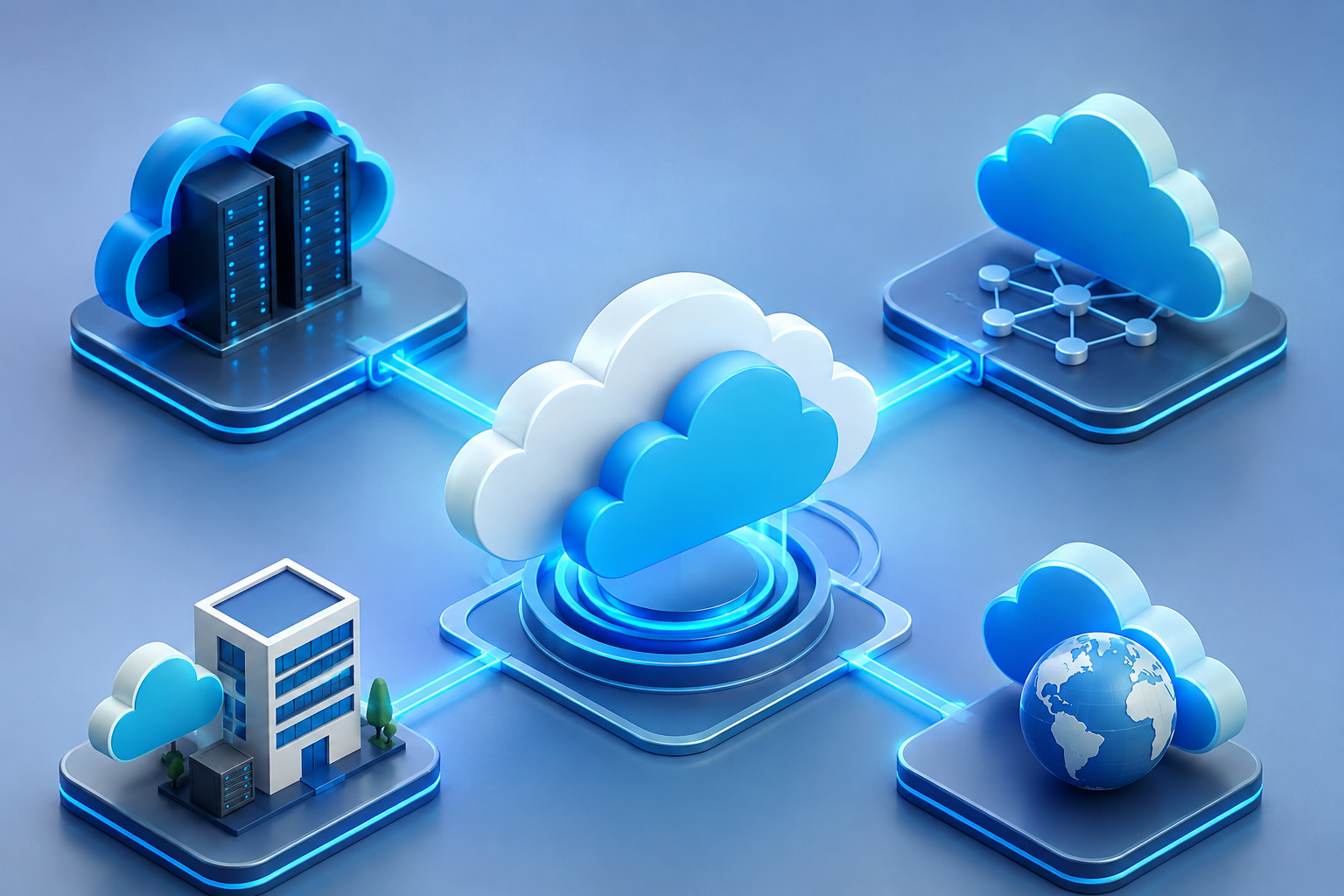
Cloud computing has been an integral part of digital transformation, empowering agility, scalability, and innovation in various industries. The fundamental drivers of this transformation are cloud deployment models, and the various ways companies are organizing and accessing cloud services. The decision is made based on technology, business priorities, compliance and long-term growth.
This article aims to compare the significant deployment modes and explain their pros, cons and scenarios. It also reviews adoption trends and new developments to assist organizations in determining which adoption factor (or combination) is right for them.
What is a Cloud Deployment Model?
A cloud deployment model is a framework that provides a specific definition of how and where an organization’s cloud infrastructure is hosted, managed and made available. It refers to who owns the infrastructure, who can use it, how many can use it, and who is responsible for keeping it safe and in good order. This classification is used to indicate whether resources are allocated to one organization, shared between multiple organizations or provided via a mix of environments.
While the deployment models determine where your infrastructure is going to reside and how it is going to be governed, the service models determine the resources you are providing and how the management responsibilities are divided. As a whole, service models span a spectrum from IaaS to complete, ready-to-use applications (SaaS) and from abstracting the runtime and development tools (PaaS) to providing managed container orchestration environments (CaaS). The difference is in that deployment models deal with where and by what authority the cloud works, while service models deal with what it does and the division of responsibilities.
Governance, compliance, sovereignty and network architecture are all factors taken into account when selecting deployment models. Service models are selected based on the requirement of agility, operational overhead, scalability and control. They together make up the operational and strategic posture of a cloud environment.
Types of Deployment Models
The primary deployment models are public, private, hybrid, community and multi-cloud. They each come with their own set of benefits and drawbacks and can be used for different sorts of business needs.
1. Public Cloud Deployment Model
The public cloud is the most common deployment model, in which the owner, manager and operator of the infrastructure and services are a third-party cloud provider. This type is hosted in the provider’s data centres and is shared among multiple organisations via the internet. Shared resources are used by tenants while ensuring that each customer’s data stays safe and secure thanks to strict isolation mechanisms.
Public cloud providers handle all aspects of infrastructure management, including physical security, maintenance, updates and compliance with industry regulations. This saves organisations the expense or need to invest in or maintain their own data centres. The majority of services use per-use pricing and can be used via a web-based interface, command line tools, application programming interfaces, and/or infrastructure-as-code solutions such as Terraform. The infrastructure is common, but the providers can provide you with dedicated or isolated hardware, depending on the compliance or performance requirements of the workloads.
Public clouds are perfect for businesses that need to deploy quickly with minimal CAPEX, scalable applications, and dynamic workloads.
Benefits of Public Cloud
- Cost Efficiency: No need to buy hardware and facilities; no location or procurement restrictions – pay-as-you-go model.
- Low Management Overhead: The provider takes care of all the infrastructure operation, thus eliminating the need of having separate in-house IT staff.
- Rapid Vertical and Horizontal Scaling: Virtualization allows for quick scaling up and down to accommodate varying workloads.
- Reliability: Built-in redundancy and distributed infrastructure ensure high availability and minimal service interruptions.
- Multiple Service Models (IaaS, PaaS, SaaS): Supports multiple models, and can be accessed from any device with internet connectivity.
- Designing for Public Cloud: Design for Public Cloud. Performance and flexibility can be impacted during peak usage periods with Multi-tenant architecture. Resource Contention.
- Data Sensitivity Risks: May not be suitable for workloads that have strict compliance or regulatory requirements because of shared infrastructure.
- Security Exposure: Public areas with large concentrations are frequently the subject of cyber attacks and data protection becomes key issue.
- Limited Customization: Provides minimum configuration options (VM size, OS), and does not allow for a deep customization of infrastructure and networking.
2. Private Cloud Deployment Model
A private cloud is a cloud service that is used exclusively by one organisation. A private cloud is a cloud that uses hardware, storage and network resources that are dedicated to the needs of one entity, as opposed to a public cloud where infrastructure is shared among multiple tenants. It could be run in the organization’s own data centre or in a third-party data centre, but in either case it is run within a controlled, secure environment, whether within the organisation or under their own contract.
Private clouds are intended for organizations wishing to improve their security, regulatory compliance and granular control of their IT resources. The infrastructure can be customized for use with the workload, enabling more customization and governance. This type of model is generally more expensive than a public cloud-based model, since the organization must cover the costs of the hardware, software, and upkeep. Private cloud environments often use a chargeback or showback system for internal usage management and allocation of costs to departments or business units that can measure and report on the amount of usage.
Benefits of Private Cloud are:
- Exclusive Ownership and Control: Complete control of integrations, operations, compliance policies and user practices.
- Support for Legacy Applications: Allows running of databases that might not be public-cloud compatible.
- Better Data Safety: Only user access is granted to authorized people, providing better protection for sensitive enterprise data.
- Scalability Options: The infrastructure can be scaled up or down based on the specific business and workload needs.
- High Performance Reliability: stable and predictable performance, little or no external dependency.
- Granular System Configuration: More flexibility in hardware and software modifications to meet an organization’s standards.
Disadvantages of Private Cloud
- Higher Cost of Ownership: Hardware, software and skilled personnel are all costs to the organization.
- Idle capacity is direct financial inefficiency – Under-Utilisation Risk.
- Scalability Constraints: Scalability requires more hardware which is limited by procurement time and current (existing) hardware capacity.
- Time and effort required for maintenance: Internal management requires continual updating, monitoring and technical support.
- Storage limitations (potential): Physical storage can have a direct impact on workload deployment and growth.
3. Hybrid Cloud Deployment Model
Hybrid Cloud combines two or more distinct cloud deployment models, typically public clouds and private clouds, into a standardised manner that allows seamless interoperability between them. By this way, organizations can keep sensitive workloads in a controlled private cloud, and use the scalability and cost-effectiveness of the public cloud for less sensitive or fluctuating workloads.
Hybrid clouds are especially valuable for situations when cloud bursting occurs, meaning that applications are primarily deployed in a private cloud and move to the public cloud when there is a surge in demand for their services.
Hybrid cloud deployments merge private infrastructure governance and security with public cloud elasticity and reach, providing a flexible approach to address a variety of workloads. They are ideal for enterprises who are in the process of transitioning to the cloud over time, organizations with varying requirements throughout the year and businesses with regulated industries where a combination of deployment environments is needed.
Benefits of Hybrid Cloud:
Cost Optimization: Distributes workloads to both public and private environments to optimize operational costs.
Improved Security Management: Highly separated storage and distinct protocol separation make it easier to put security measures in place.
High Flexibility: Infrastructure and services are customisable to the needs of the business and its workloads.
Scalable Architecture: Deployment models are used in combination to achieve speedy scalability for meeting varying demands.
The drawbacks of Hybrid Cloud.
- Multi-cloud Management Complexity: Managing multiple clouds involves advanced integration and monitoring.
- Selective Applicability: Works best for businesses that have different workload and infrastructure requirements.
- Infrastructure Dependency: The performance and scalability of the system may be affected by the hardware and network underlying the system.
- Potential Security Risks: If not properly configured and monitored, public cloud connectivity can cause vulnerabilities.
4. Community Cloud Deployment Model
A community cloud is a shared cloud infrastructure that can be used by multiple organizations (that share common goals or are part of the same industry or sector). Access is limited to the members of the particular community and allows the members to enjoy a nonpublic cloud environment with greater privacy and security than is generally available in public clouds and in a collaborative environment.
In the financial services, government, education and research industries, where compliance needs are comparable, as are operational objectives and data protection requirements, this model is frequently implemented. Government Clouds, otherwise known as community clouds, can also be used to satisfy various jurisdictional requirements and data sovereignty laws, as it guarantees that infrastructure will be accessible within the specified legal borders.
Benefits of Community Cloud
- Cost Sharing: Members share the cost of infrastructure, thus reducing relevant costs relative to private dedicated infrastructure.
- Scalability and Flexibility: Capacity can be expanded or reduced as per the requirements of the community and can accommodate variable research or academic workloads.
- Reduced Policy, Controls and Protocol Variability: Policies, controls and protocols are aligned to sector requirements, enhancing efficiency and audit readiness for regulated domains.
Pooled resources and coordinated operations increase reliability, making this model ideal for government projects, education and consortium projects.
Limitations of Community Cloud
- Limited capacity: Bandwidth and storage may be limited compared to hyperscale public clouds and impact data intensive workloads.
- Security Maintenance Burden: There is a need for skilled personnel and a more robust governance framework across the participating organizations to meet high security standards.
- Greater Collective Overhead: The upfront setup and maintenance expenses are on-going and continue even if shared and may be higher than those associated with public cloud options.
- Limited Flexibility: Lacks many of the features of a private cloud and may not offer as many services as a public cloud.
5. Multi-Cloud Deployment Model
Multi-cloud deployment is when multiple public cloud service providers are used at the same time. Multi-cloud strategies use multiple public clouds to spread workloads and data instead of a combination of private and public infrastructure as in the hybrid cloud model. By doing so, organisations can capitalise on the advantages and benefits of varying providers including services, pricing, and geographic availability, while lowering dependence on a single provider.
Resilience is one of the main reasons for adopting multi-cloud. Multi-cloud can help reduce the risk of a single outage affecting the entire infrastructure by distributing workloads and databases across multiple providers. Because it is very unlikely for two independent public cloud services to fail at the same time, this approach greatly increases uptime and service continuity.
Multi-cloud deployments are also adopted to comply with regional rulesets, to optimize performance by putting workloads nearer to the end users, to prevent vendor lock-in. This flexibility does have some caveats, though – it requires integration, governance and monitoring to effectively manage multiple environments.
Benefits of Multi-Cloud
- Provider Specialization: Allows for access to the best-in-class service from various providers, tailored to the application, workload or business needs.
- Optimized Performance: Delivers lower latency and better user experience by placing workloads in geographic regions nearer to end users.
- Higher service reliability: Risk of downtime is reduced, since failure at one or more independent cloud platforms is very rare.
Limitations of Multi-Cloud
Data Transfer Costs: Large volumes of data can be costly to transfer between providers.
Operational Complexity: Needs to have multiple deployment and integration pipelines, and their design, implementation and maintenance.
Distributed Architecture across multiple providers creates visibility, incident response, and performance monitoring challenges.
The Selection of the Right Cloud Deployment Model
The following are some of the major factors to consider when choosing the cloud deployment model:
Business Goals: Ensure that the selection fits the organization’s business goals and requirements, including cost optimization, scalability, security, and compliance. Evaluate the sensitivity of data, workload and geographic needs.
Model Suitability:
- Private Cloud – When strict security, compliance and customization requirements are desired.
- Public Cloud is the cloud that offers scalable, cost-efficient, fast deployment, and is accessible to a wide range of people.
- Hybrid Cloud – Flexibility, workload mobility and optimized resource utilization.
- Provider Capabilities: Benchmark features, integration support, geographic availability, SLAs, and service portfolios of top providers.
- Cost Structure: Review total cost of ownership, pricing models and possible savings including operational and capital cost.
- Scalability & Performance: Make sure that the model can handle growth projections, seasonal fluctuations, and performance needs; including auto-scaling and distributed computing.
- Security & Compliance: Assess encryption, identity & access and relevant compliance certifications – particularly in regulated industries.
Choosing the right deployment model involves weighing various technical aspects against strategic objectives to ensure it not only achieves the desired efficiency but also possesses the flexibility needed for future growth and changes. The Inspirisys cloud services are developed for enterprises to construct secure, scalable and cost-efficient surroundings based on their operational objectives. Whether it’s designing the architecture, optimizing it for migration, or managing it going forward, we ensure a seamless and future-proof transformation.
Future Trends in Cloud Computing
Cloud Computing is in the midst of a period of accelerated diversification and specialization. New technologies, changing security needs and sustainability objectives are ushering in a new era of infrastructure deployment, management and optimization. These trends demonstrate the direction of the cloud world and the future of the next generation.
1. Rise of Multi-Cloud Strategies
Cloud adoption is growing in the enterprise, with many choosing to take a multi-cloud approach to accessing best in class services, optimizing workloads and de-risking their reliance on a single cloud provider. This helps to increase resilience as well by reducing the chance of downtime due to provider failures.
2. Growth of Edge Computing
Offloading tasks to local servers or IoT devices for analysis reduces latency, speeding up the process for insight. It is essential for applications such as smart cities, healthcare, autonomous systems, and others that require real-time processing.
3. Serverless Architectures are expanding.
Serverless computing eliminates the need to manage servers, thereby enabling faster application deployment, cost savings in operational resources, and concentration on the business logic and code.
4. Advanced Cloud Security
AI systems are increasingly being adopted for threat detection, while machine learning analytics and zero-trust security principles like NIST Zero Trust Architecture (SP 800-207), CISA Zero Trust Maturity Model, and CSA’s Zero Trust Advancement Center are becoming the norm. Along with automated monitoring and compliance solutions, these frameworks are assisting organizations to tackle advanced cyber risks and satisfy laws like GDPR, HIPAA and CCPA.
5. Sustainability in the Cloud
Environmental issues are being tackled through green cloud programs, such as data centers that use energy efficiently, utilization of renewable energy, and efficient cooling systems, among others, which also reduce costs.
Conclusion
Cloud deployment models change as businesses change, regulatory environments change, and technology does as well. The best approaches are those that acknowledge that what is “right” for today’s workloads, compliance requirements and market conditions may need to be adjusted tomorrow.
Assessing the success of the deployment using governance, performance, cost efficiency and adaptability provides a good view of how well the infrastructure matches the current and future goals. Trends in the new era of distributed cloud, edge integration and AI-powered security are changing the game, and the ability to reconfigure and optimize cloud environments will be a major differentiator as key.
Frequently Asked Questions
1. What is the role of AI in cloud Computing?
By leveraging AI, cloud computing can be more efficient and capable of making intelligent decisions, such as predictive analytics, auto-scaling resources, sophisticated security threat detection, and intelligent workload management.
2. How does disaster recovery work in the cloud?
Cloud-based disaster recovery provides application and data resynchronization and backup services across data centers in different geographic locations and quickly restores applications and data in the event of an outage or failure, minimizing downtime and data loss.
3. What is serverless computing and how is it different from traditional cloud hosting?
With serverless, developers can deploy code without having to manage servers or infrastructure. The cloud provider automatically provisions, scales and manages resources, billing for execution time and not fixed capacity.
4. What is cloud bursting?
A hybrid cloud solution in which an app is deployed in a private cloud and “bursts” into the public cloud when it experiences peak demand.
5. How can cloud computing help to streamline IT operations?
Cloud computing allows people to work remotely – by accessing applications, data and collaboration tools securely and at scale, from any internet-connected device, in flexible ways.