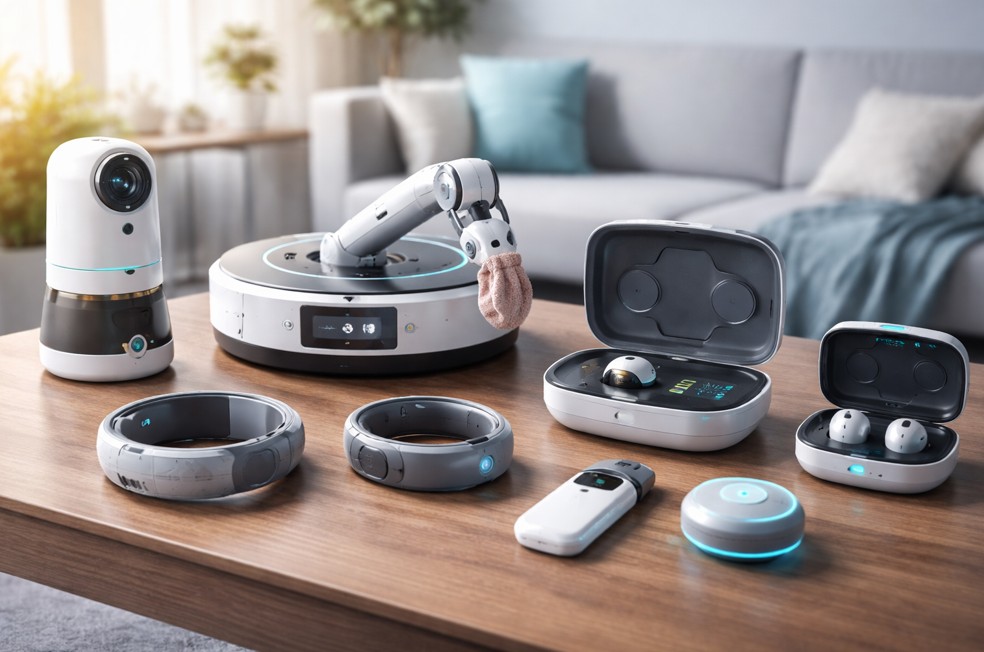
Artificial Intelligence isn’t just for ChatBots and Cloud services. In 2026, it will be an integral part of many consumer electronics, including laptops equipped with dedicated Neural Processing Units (NPUs) and smart glasses that allow for real-time translation of conversations. With a growing AI-powered device landscape, consumers are forced to choose from among a myriad of manufacturers who are scrambling to offer them the quickest and most personalized experiences.
If you are searching for Droven.io new gadgets 2026, you may be taking a look past marketing claims. You’re looking to know what sorts of devices offer real innovation, what impact on-device AI has on performance and privacy, and what gadgets you should invest in.
In contrast to a number of roundup pieces that just list products, this guide takes the time to explore the technology behind the modern gadgets, discuss emerging trends, and even show how AI hardware, edge computing, and intelligent automation are driving the next generation of consumer electronics.
What Are Droven.io New Gadgets 2026?
Droven.io new gadgets 2026 typically covers the most recent group of consumer gadgets introduced or mentioned on the Droven.io site, such as AI gadgets, wearable innovation, smart home items, effectiveness gadgets, and arising electronics.
Edge AI is a defining trend in almost all of the categories. Many modern gadgets today can perform AI functions locally through embedded hardware accelerator chips like Neural Processing Units (NPUs), instead of all in the cloud. There are a number of benefits to this:
- Faster AI responses
- Lower latency
- Improved privacy for sensitive data.
- Reduced internet dependency
- Better battery usage for supported workloads
Consequently, users can enjoy real-time translation, AI-powered photo editing, voice assistants, and document summarization on their device.
Did You Know? Companies like Qualcomm, Intel, AMD, and Apple have developed modern processors that can help power up machine learning tasks while consuming less power than using a CPU processor.
Why AI Gadgets Are Defining Consumer Tech in 2026
The consumer electronics revolution isn’t just about improved hardware, it’s about the incorporation of AI into the daily routine. The devices are no longer simply assistants; they anticipate the user’s needs and automate normal tasks.
The following are some of the capabilities now emerging in various product categories:
- Intelligent voice interaction
- Real-time language translation
- AI-enhanced photography
- Context-aware notifications
- Adaptive battery management
- Personalized productivity features
- Offline AI processing
- Smart health monitoring
The evolution is made possible by advancements in AI models, semiconductor design, and on-device inference techniques that deliver more sophisticated experiences, even without constant internet connection.
Pro Tip: When assessing AI gadgets, keep an eye out for features promised as well as the fact that some features require an internet connection while others do not. Local processing can help increase responsiveness and provide better privacy.
Who Could Have Predicted the Emergence of the Top Categories of Droven.io New Gadgets 2026?
It’s better to grasp the overall market segments affecting the industry rather than the specific products.
1. AI Wearables
Wearables are increasingly becoming smart health & productivity partners. The new devices feature sensors and AI models that increasingly deliver more precise sleep pattern analysis, activity tracking, and wellness data.
Common features include:
- Continuous HR monitoring.
- Sleep quality analysis
- Stress detection
- Fitness coaching
- Voice interaction
- Contactless payments
The vast majority of wearables today can communicate with more comprehensive systems, enabling the wearer to control notifications, calendars and smart home devices from their wrist or finger.
2. Smart Home Devices
Smart home technology keeps developing towards more interoperability. Standards, such as Matter, allow for greater reliability between different devices from various manufacturers, making setup and utilization easier.
Popular innovations include:
- AI-enabled security cameras
- Intelligent thermostats
- Smart lighting
- Automated blinds
- Voice-controlled appliances
- Connected kitchen devices
AI improves these systems by learning and optimizing automation through user patterns, based on daily usage.
A “smart home” is more of an ecosystem of well-designed devices than a group of devices working independently. Reviewing product options for common standards can help to ensure long-term compatibility.
3. AI PCs and Productivity Devices
One of the key developments expected in 2026 is the launch of AI-powered dedicated hardware for laptops and desktops. The systems are intended to speed up machine learning processes as well as power savings.
Potential benefits include:
- Faster document summarization
- AI-assisted content creation
- Enhanced video conferencing
- Real-time transcription
- Background noise reduction
- Create local images and image editing.
On-device AI will be ubiquitous in productivity devices as it becomes more common in software.
Smart Audio and Communication Devices.
AI is also driving change in how users communicate and interact with media.AI is also shifting user communication and media consumption. Modern earbuds, speakers and communications devices can do things like:
- Live translation
- Adaptive noise cancellation
- Voice isolation
- Personalized audio tuning
- Context-aware voice assistants
These features are designed to help to ensure natural communication and minimize distractions in everyday situations.
Did You Know? Audio processing algorithms can be powered by AI to adapt the audio profile according to the surrounding sounds, which results in a clearer call and listening experience without user interaction.
Real World Use Cases of AI Gadgets in 2026
The significance of Droven.io new gadgets 2026 is not just about the latest gadgets, but also about their impact. Across homes, offices, healthcare, education, and content creation, these devices are increasingly finding practical applications to solve problems.
Smart Home Automation
Smart home systems with AI capabilities adapt to user behavior; they don’t just enforce pre programmed automation rules. Modern ecosystems can:
- Detect unusual activity through intelligent security cameras
- Vary the lighting according to occupancy.
- Optimize heating and cooling schedules
- Reduce energy consumption
- Send out predictive maintenance warnings
With the increasing development of interoperability standards, users can operate with various products of different manufacturers in a single system.
Productivity Enhancement
AI productivity tools and devices help professionals by taking care of repetitive tasks.
Common capabilities include:
- Meeting transcription
- Document summarization
- Email drafting
- Image enhancement
- Background removal
- Voice isolation
- Calendar organization
These features enable the professionals to focus on high-value tasks and reduce the time they invest in routine tasks.
Healthcare and Wellness
Wearable tech is continuing to transcend fitness tracking.
Recent advancements include:
- Continuous heart monitoring
- Sleep quality analysis
- Stress detection
- Oxygen saturation monitoring
- Personalized wellness recommendations
AI algorithms look at trends over time and can alert users of any changes that might require medical attention.
Education
AI-powered devices are enhancing students’ ability to benefit more every day:
- Real-time translation
- Intelligent note generation
- Interactive tutoring
- Voice transcription
- Research assistance
These tools do not replace learning, they are tools to streamline administrative tasks and make it more accessible.
Content Creation
Creators are now using AI technology in their hardware for:
- Video editing
- Photo enhancement
- Automatic captions
- Noise reduction
- AI-assisted design
- Mobile content production
These tasks are aided by dedicated AI processors, which do not rely mainly on cloud services.
How to Choose the Right AI Gadget
When buying a device, check it out with these points in mind.
1. AI Processing Capability
Decide where the device runs AI functionality, either locally or on cloud servers.
Local processing typically offers:
- Faster performance
- Better privacy
- Reduced latency
- Offline functionality
2. Ecosystem Compatibility
See if the gadget works with the other gadgets you have.
Questions to ask:
- Is it supported by Android?
- Is it iOS-friendly?
- Does it work with M, N, O?
- Does it work with your smart home?
3. Software Updates
Firmware and software updates make AI devices much better.
Look for manufacturers who have a good reputation for long-term support.
4. Battery Life
AI workloads require extra power.
Compare:
- Typical usage
- AI feature runtime
- Fast charging
- Battery replacement options
5. Privacy
Sensitive data can be analyzed by some AI devices.
Review:
- Data encryption
- Local storage options
- Cloud dependency
- Privacy policies
As a general rule, steer clear of gadgets that promote “AI” as their primary feature. Be specific on how the AI enhances your productivity or everyday life.
Common Buying Mistakes
- A lot of consumers buy AI devices for marketing.
- Avoid these mistakes:
- When you purchase a product, make sure to do so with a view to its compatibility.
If a gadget that promises a great deal of value does not work with your devices, it simply cannot be a premium gadget.
Ignoring Software Support
A security patch is necessary for maintenance of the usefulness of the hardware, if manufacturers keep releasing security patches and feature updates.
Overlooking Privacy
- Some devices stream voice data or personal information to a cloud server all the time.
- Ensure you know what your data is being processed for before buying it.
- Still, you’re paying for features you will never use.
Select products that address your unique needs and issues instead of the ones that have the most features.
Believing Every AI Claim
Not all smart features are based on sophisticated artificial intelligence.
Some products make use of simple automation and are using ‘AI’ mostly as a marketing term.
Future Trends Beyond 2026
The consumer electronics sector is quickly heading toward more advanced, more efficient, and more connected AI systems.
Emerging trends include:
- Complete AI offline assistants.
- Ambient computing
- AI-powered robotics
- Personal AI agents
- Smarter mixed-reality devices
- Energy-efficient AI chips
- Multi-device AI ecosystems
- Context-aware personal assistants
As the models get better and more efficient, users will enjoy more and more advanced capabilities without compromising privacy and battery life.
Conclusion
AI hardware is rapidly changing consumer technology. Today’s gadgets are much more intelligent than mere connected devices, they are increasingly capable of interpreting context, of automatically performing repetitive tasks and of processing information on the device.
Do not consider new gadgets that rely on marketing hype, consider those that offer quantifiable benefits in productivity, privacy, health monitoring and interoperability. The value is increasing in the quality of features like dedicated AI processors, edge computing capabilities and long-term software support, rather than just specifications.
With the AI hardware ecosystem further maturing, buyers who grasp these tenets will be at greater advantage when it comes to buying into devices that can continue to be useful well beyond 2026.
Frequently Asked Questions
What are the best new gadgets in 2026?
The best-known types of gadgets include AI laptops, smart rings, AI wearables, smart home devices, smart glasses, and productivity accessories. The devices with local AI computing and everyday functions offer the most value in the long term.
Which AI gadgets are worth buying in 2026?
AI gadgets are worthy of purchase if they address genuine issues, for instance, improving productivity, automating important errands, refining correspondence or adding to wellbeing checking. Choose devices that have stable software support and a good software ecosystem.
Is Artificial Intelligence safe?
A good AI gadget will have security measures like encryption and secure authentication. But, users are advised to check privacy settings, be aware of the handling of personal data, and to regularly install firmware updates.
What is Edge AI?
Edge AI is the use of AI technology on the edge, not in the cloud. It does this to minimize latency, boost privacy and help many AI capabilities operate without internet connection.
Before purchasing an AI gadget, what are some factors I should take into account?
Assess the capabilities of AI processors, their compatibility with the ecosystem, battery life, software support, privacy measures, and the usefulness of the AI capabilities provided by the processor. Don’t buy anything just because it’s advertised as having “AI”.