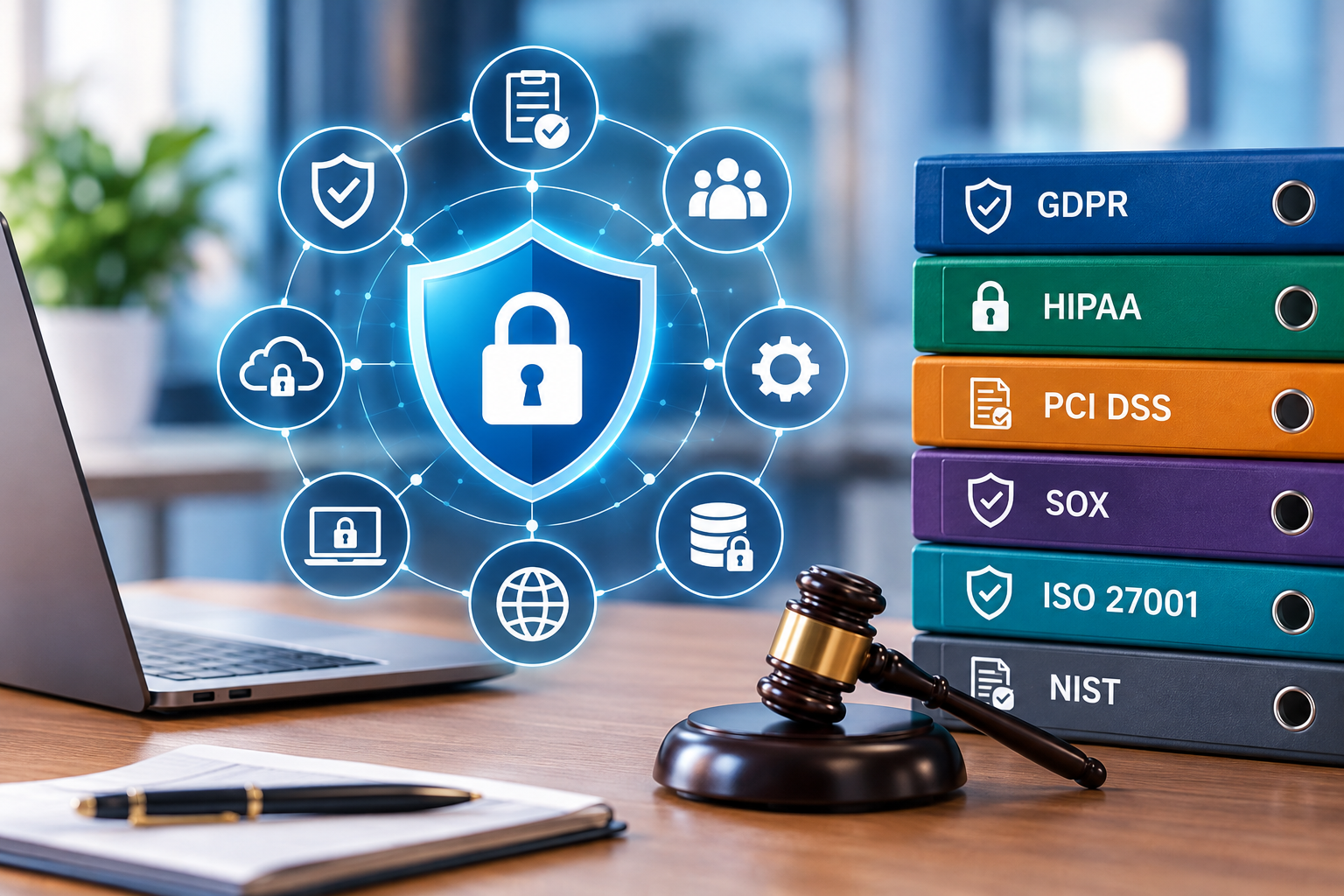
What is Cybersecurity Compliance
Cybersecurity compliance is the process of following laws, standards and regulatory requirements set by governments and industry regulators. The compliance regulations are meant to safeguard a business’ digital information and information systems from unauthorized access, use, disclosure, disruption, modification or destruction.
Compliance with cybersecurity is normally accomplished with the help of risk-based controls, safeguarding the information that an organization stores, processes, integrates, or transfers, which has its own confidentiality, integrity and availability.
The Most Essential Elements in Cybersecurity Compliance
By complying with cybersecurity regulations, organizations can be sure that they have the ability to enforce the validity of their security controls, and therefore better prevent data breaches, protect customer information, maintain reputation and improve security posture. Compliance also means that organizations are aware of and in control of their risk to the security controls that can help them avoid regulatory fines and noncompliance litigation. Factors to consider for compliance include:
- Regulatory Requirements: Adhering to industry or region-specific laws and regulations (e.g., GDPR, HIPAA, CCPA).
- Industry Standards: Compliance with industry standards and frameworks, including ISO/IEC 27001, NIST Cybersecurity Framework, PCI-DSS, etc.
- Policies and Procedures: Development and implementation of internal policies and procedures that conform with regulatory and industry needs.
- Risk Management: Carrying out risk assessment to detect vulnerabilities and threats, and risk mitigation plan.
- Access Control: Regulating access to critical systems and data by only granting access to authorized users.
- Data Protection: Creating strategies to prevent unauthorized access of data, data breaches, and any other security issues.
- Incident Response: Creating an incident response plan to effectively manage security incidents and mitigate their impact.
- Training and Awareness: Conducting regular training and awareness sessions for staff to ensure understanding and adherence to cybersecurity policies and procedures.
- Auditing and Monitoring: Conducting regular audits and monitoring of systems, vendors and processes to ensure continuous compliance and opportunity for improvement.
- Reporting and Documentation: Keeping comprehensive records and documentation to prove adherence to regulations and standards, and for the purpose of regulatory audits.
Cybersecurity Regulations & Compliance by Industry
However, in particular industries, cybersecurity maturity is a regulatory mandate as well as a best practice. These regulations are difficult and ever-evolving. Let’s dive into some of the major cyber compliance regulations by industry to help you understand your organizations regulatory landscape and the cyber security requirements and controls that they require.
1. Healthcare
Perhaps the best-known healthcare cybersecurity compliance regulation is the Health Insurance Portability and Accountability Act (HIPAA), which affects everyone.
HIPAA mandates for healthcare organizations, insurers, and third-party service providers to put controls into place to secure and protect patient information and conduct risk assessments to uncover and address new risks. Despite HIPAA’s 1996 debut, the industry continues to have trouble keeping up with compliance, it seems, given the research from Bitsight.
2. Financial Services
As a lucrative target for bad actors, the financial services cybersecurity compliance landscape is abundant with regulation. The most common set of regulations are found in the Federal Financial Institution Examination Council handbook (FFIEC IT). Continuous monitoring and business continuity management (BCM) have been a focus both internally and throughout the supply chain, as recently as 2020.
One of the other regulations is the Service Organization Control (SOC) Type 2 (SOC2). SOC2 is an extensive and comprehensive cyber security compliance framework developed by the American Institute of Certified Public Accountants (AICPA) that is designed to assist companies in verifying that third parties are securely handling client information and storing it in accordance with the trust agreement. Beyond securing digital systems, financial services firms will have to adhere to the Gramm-Leach-Bliley Act and inform customers of the disclosure and sharing practices for their data, as well as when the data might have been compromised.
Oh, and financial regulators have a number of frameworks to guide compliance with cybersecurity standards. For example, the Office of the Comptroller of Currency (OCC) has issued guidelines for the oversight of third-party risk. Their guidance is given to all their organizations under their chairmanship.
3. US Federal & Government Contracts
With the Office of Personnel Management (OPM) and SolarWinds supply chain attacks having come in massive waves during the last two years – with the former in 2015 and the latter in 2020 – it’s no wonder the government is stepping up its push on regulations that address today’s persistent and evolving threats.
Let’s discuss what’s changing!
The Biden administration released an Executive Order (EO) in May 2021 for the protection of federal infrastructure. Some of the other elements of the EO involve new standards and tools for federal agencies to use to help ensure that software supply chains are secure, as well as guidelines to be used in monitoring and evaluating the security practices of third-party software developers. Also, government contractors must inform customers if their data may have been compromised as the result of a cyber-attack.
Biden’s EO reinforces a wide variety of government cybersecurity policies. The Federal Information Security Management Act (FISMA) is the most thorough cybersecurity compliance framework that has been developed so far.
The act is very similar to FIPS and NIST 800 and establishes standards for first party and third party compliance. For a government sector business, learn what FISMA is and how to keep track of FISMA compliance. In the defense sector, businesses must meet cyber requirements set up in the Defense Federal Acquisition Regulation Supplement (DFARS) and Procedures, Guidance, and Information (PGI). They also have to meet the new Cybersecurity Maturity Model Certification (CMMC) standard for defense contractors, which calls for assessments of defense contractor security postures. Determine if your business is prepared for the CMMC.
4. Energy
It won’t be the last breach in the long line of attacks targeting the U.S. energy sector, but the Colonial Pipeline incident is the latest. Oil and energy companies fare worse in the Bitsight research ratings with 62% of them rated as being at high risk of ransomware attacks because of their weak cybersecurity posture. Almost 100 of them are 4.5 times more likely to suffer such an attack.
These companies should now thoroughly review their security programs to find any weaknesses, especially in their configuration management, patching, vulnerability management and endpoint security. They also need to ensure that they meet the North American Electric Reliability Corporation – Critical Infrastructure Protection (NERC CIP) cybersecurity requirements. Learn about the ways to be NERC-CIP compliant.
Finally, the Federal Energy Regulatory Commission’s (FERC) Critical Infrastructure Protection (CIP) Standards must be followed by energy companies.
5. Consumer Businesses
For businesses which interact directly with consumers, like restaurants, retailers and consumer product businesses, digital technologies and data efforts are becoming more critical to enhancing the customer experience. Whilst these interactions rely on customer data, legislation mandates that businesses safeguard and also ensure consumer data personal privacy.
Some examples include the new regulations of the General Data Protection Regulation (GDPR), which has imposed new requirements on businesses collecting and storing the private information of European Union citizens, including U.S. companies. The fines are large, up to a maximum of EUR 20,000,000 or up to 4% of worldwide turnover and the EU is not hesitant to impose them. The California Consumer Privacy Act (CCPA) passed in 2018 provided similar legislation. Other states are starting to follow suit as well. In May 2021, the Commonwealth of Virginia passed a Consumer Data Protection Act, which adds data protection assessment requirements.
6. Publicly Traded Companies
The Securities and Exchange Commission (SEC) has recently adopted new regulations on disclosure requirements around cybersecurity for publicly listed companies in 2023. The rules impose new requirements to report material cybersecurity incidents and to provide critical information concerning cybersecurity risk management, cybersecurity expertise and cybersecurity governance. The disclosure of risks will start in companies’ annual reports from December 15, 2023.
The SEC also encourages companies to have policies and procedures in place to prevent insider trading based on nonpublic information about cybersecurity risks and incidents. Non-compliance with these rules may lead to regulatory action, investor litigation and reputation damage.
7. Retail
There is no federal regulation for the retail sector but there are regulations from the Payment Card Industry Security Council’s Data Security Standard (or PCI DSS).
Any organization that process, store or transmit payment cardholder information are required to follow regulations from PCI DSS which stipulates standards for securing cardholder data. In fact, there are several requirements in PCI DSS that relate to identifying, monitoring and remediation of software vulnerabilities that if exploited by the threat actor, can compromise the security of payment cardholder information.
8. Defense
As a condition of providing a service to the U.S. Department of Defense (DOD), businesses must meet cyber requirements set up in the Defense Federal Acquisition Regulation Supplement (DFARS) and Procedures, Guidance, and Information (PGI). DFARS provides cybersecurity requirements and obligations for a third party before they enter into business with the DOD to safeguard sensitive defense information.
9. Insurance
State rules and regulations for insurance departments and companies differ, but many have established mandates to safeguard consumer information. Moreover, there has been more discussion about enhancing the regulations in this field. In October 2016, the New York State Department of Financial Services (DFS) proposed new regulation around cybersecurity for both financial organizations and insurance companies.
What is The Challenge of Cybersecurity Compliance?
Whether it’s the general regulations on data in Europe, the California Consumer Privacy Act, PCI DSS, or HIPAA regulations, CISOs are being pressured to meet multiple requirements and standards covering sensitive information security and data protection.
The stakes are big as well. When it’s not possible to meet and sustain legal requirements, fines and litigation can easily run up millions of dollars. The effect when failure to comply is a factor in a cyber attack or data breach can be even more devastating. Breaches typically cause customers to lose confidence and stock to prices drop. Customer confidence is lost, and there is a loss of profitability.
Solutions can meet several objectives to achieve compliance with the wide range of regulations. Implementing cybersecurity compliance technology requires it to be able to:
- Identify and address data risk and system vulnerabilities, aligning them with business regulatory objectives.
- Provide visibility, enhance enforcement and demonstrate efficacy of the security controls needed to meet compliance.
- Provide the capability of a prioritised approach to cyber security compliance, based on risk.
- Implement automated and streamlined data security and privacy programs.
- Remove compliance silos, cut down on excess controls and enable executives to get answers faster.
Minimize Security Assessment Control Creep
- Minimize the administrative burden of risk assessments, and improve efficiency of staff working on security risk management.
- Reduce cyclical security and/or IT audit or assessment expenses.
Compliance Summary
Cybersecurity compliance is an important objective for organizations in these industries, but you can enhance your cybersecurity program by adopting common cybersecurity frameworks like NIST, ISO 27000 and CIS 20.
Evaluate and rate your cybersecurity posture with Bitsight Security Ratings and watch your third parties at all times to make sure they’re not an unknown threat to your network. By using the framework of cybersecurity compliance as a guidepost, and Bitsight’s understanding of what regulators are seeking, you can better understand what regulators are looking for and continue to grow your cybersecurity performance.
Furthermore, when it comes to PCI DSS compliance, Bitsight Cyber Threat Intelligence can also improve the vulnerability assessment and prioritization process. Bitsight CTI is based on the most recent vulnerability exploit intelligence provided by the cybercriminal underground, and accurately predicts which vulnerabilities are most likely to be exploited in the next 90 days. This intelligence enables security teams to more effectively prioritize these vulnerabilities to increase security and ensure cybersecurity compliance with PCI DSS requirements.