AI is transforming the way users create, communicate and work. Intelligent technologies are increasingly coming to the fore in day-to-day digital processes, whether that’s in writing and graphic design, video production, or software development. The AI generator is one of the most notable advancements in this evolution, as it can produce new content based on instructions, data, or user prompts. As these evolutions continue, these technologies will be increasingly relevant and practical to businesses, creators, marketers, educators, and consumers.
How Generative AI is changing the world
In the past few years, the advancement of generative AI has been remarkable. Previous systems have been built for specific tasks and current systems can interpret natural language, recognize patterns, consume multiple media formats, and produce new and attractive pieces of media.
Today’s AI generator apps support text, images, audio, video and code. Users can give a straightforward description, and the system can convert that description into something useful that can be digitized. This rapid advancement is owing to advancements in machine learning, natural language processing, computer vision, and big data computing.
This technology is also getting easier to use. Many platforms offer simple interfaces, and users can talk to them in plain English, rather than needing to know advanced programming.
Multimodal AI Will Become More Important
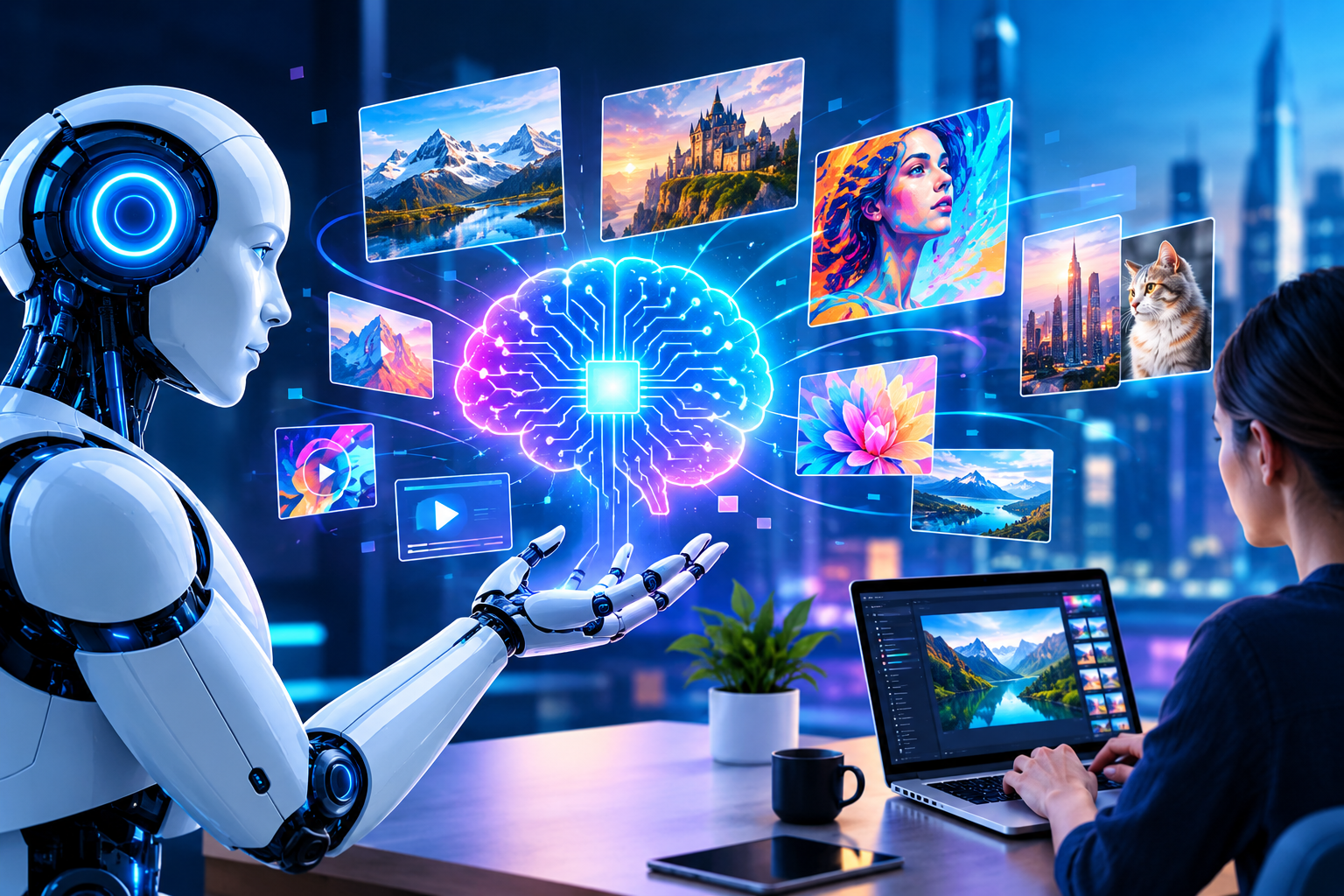
Multimodal artificial intelligence is one of the biggest trends in the future. Future systems will not only be aware of text, but will also be able to understand and combine image, audio, and video data.
For instance, a business could upload a product description and a number of photographs of their product and receive a whole marketing campaign with social media captions, promotional images, short videos, and advertising content. This integration can shorten the amount of time that’s needed to transition from ideation to campaign completion.
Accessibility can also be enhanced by multimodal systems. However, the users would be able to communicate with technology using voice, visual, written, or all three of these methods, providing greater flexibility in the form of digital experiences.
Personalized Content Creation
Personalization is also a big field of innovation. There is greater demand than ever for content and digital experiences to be relevant to consumers’ interests and needs. AI systems could potentially streamline the creation of personalized content and make it more achievable for enterprises to do so at scale.
An AI generator can already assist you in making messages suitable for various audiences, sectors, platforms and communication styles. The more models can learn to understand context, the more possible personalization might be increasingly specific with less manual effort.
For instance, a popular online retailer might have various product descriptions for customers who are novices, business customers, or those looking to spend less. Likewise, marketers might adjust campaigns for various countries, regions, and customer base.
AI and Digital Marketing
Generative AI is expected to continue playing a key role in digital marketing. Blog posts, ads, videos, images, product descriptions, email marketing all call for marketing teams to write content on a regular basis.
AI tools can help with brainstorming, drafting, editing, researching, and variations of content. This doesn’t rule out human marketers, by any means. Rather, it can help teams focus more time on strategy, creative direction, research on the audience, and brand development.
Also, future systems could integrate with more marketing analytics. With the addition of content generation and performance data, platforms might be able to assist marketers in recognizing patterns, creating variations of content based on measurable audience engagement.
Greater creativity for business and individuals
Some obstacles to creative production are also being reduced with generative technology. With the advent of new tools, anyone with an idea, but not the requisite design or technical knowledge can now experiment with ideas that were once reserved for the professionals and/or specialized software.
For writers, they can generate outlines; designers can explore ideas on the visual front; developers can get code ideas; and entrepreneurs can create early marketing materials. This ease of access could spark more experimentation and innovation in other industries.
But human direction will still remain a very key factor in creative quality. The use of effective prompts, editing, fact checking, brand knowledge and creative judgment are still vital to the production of reliable and meaningful results.
Improved AI-Powered Video and Audio
The generation of video and audio is in rapid development. Successive platforms will generate ever more realistic animation, voice over, sound effects, presentations and video sequences based on fairly basic instructions.
This might be used in advertising, entertainment, education, training, journalism, and in the internal business communication. A company could produce training videos for its employees, and educators could design their own visual learning resources.
As the technology evolves, issues of authenticity, copyright, consent and synthetic media will grow more complex. Technical innovation will then be required to go hand-in-hand with responsible development.
The Growing Importance of Responsible AI
It’s not just about what they can do – capacity is not the sole determinant of the future of generative technology. The use of these is also expected to be determined by accuracy, transparency, privacy, security and responsible use.
Information generated is sometimes not accurate, may be based on assumptions that may be biased or may contain misleading information. Companies that rely on AI content creation should have suitable review protocols. Human oversight is particularly critical in the case of content relating to legal, financial, educational, scientific or sensitive topics.
There will also be greater internal clarity around data protection policies, content ownership and disclosure, as well as what is acceptable in terms of using AI in the organization. Businesses can gain from automation with a minimum of danger by following these practices.
AI Generators and the Future of Work
The effect of AI on jobs will probably be intricate. Some repetitive tasks could be more automated and new responsibilities and job opportunities could be created related to managing, checking content, creating prompts, improving data quality, and creative supervision.
Many organizations might choose to use an AI generator as a productivity assistant instead of replacing workflows. These systems can be utilised by workers to manage preliminary drafts, repetitive tasks with content, generate ideas and perform regular content transformations, while humans are responsible for decision-making and more valuable tasks.
This change makes AI literacy more and more relevant. Workplace changes may require professionals who are familiar with assessing the outputs produced and incorporating AI tools into their work processes.
Hearing the words of the Next Generation
Going forward, there will be faster, more contextually aware, more connected AI platforms. Users might increasingly be working on integrated systems that can handle multiple tasks in a single workspace instead of multiple tools for writing, design, research, and productivity.
Having enhanced reasoning abilities might also enable generated outcomes to be useful in more complex projects. Systems can be strengthened to remember context, listen for specific details, grasp brand guidelines, and adjust outputs based on feedback.
In the long-term, it’s expected that automation will not be in opposition to human creativity, but rather will be used in tandem with it. People will remain responsible for goals, judgment, originality and ethics, while intelligent systems will be increasingly called upon to undertake increasingly complex production assignments.
Conclusion
The roadmap of generative AI is toward personalization, multi-modality, automation and accessibility. With the evolution of technology, an AI generator can be more than just a content creation tool; it can be a versatile assistant for creative, marketing, educational, and business processes.
The key to these technologies is their use: A business or individual with AI skills and the human resources of critical thinking, originality, and responsible practices will be able to attempt new methods of creation and communication. Continuing innovation and progress will mean that generative AI will continue to be a key component of the changing digital landscape.