In the last few years, machine learning has become a popular technology in the computer science world and is incorporated into different aspects of our lives. From personalized recommendations on streaming services to autonomous vehicles, machine learning is at the core of many innovations.
However, what is machine learning and how does it operate? The purpose of this guide is to provide the novice to the basics, introduce applications, and highlight future trends in this exciting field.
What is Machine Learning?
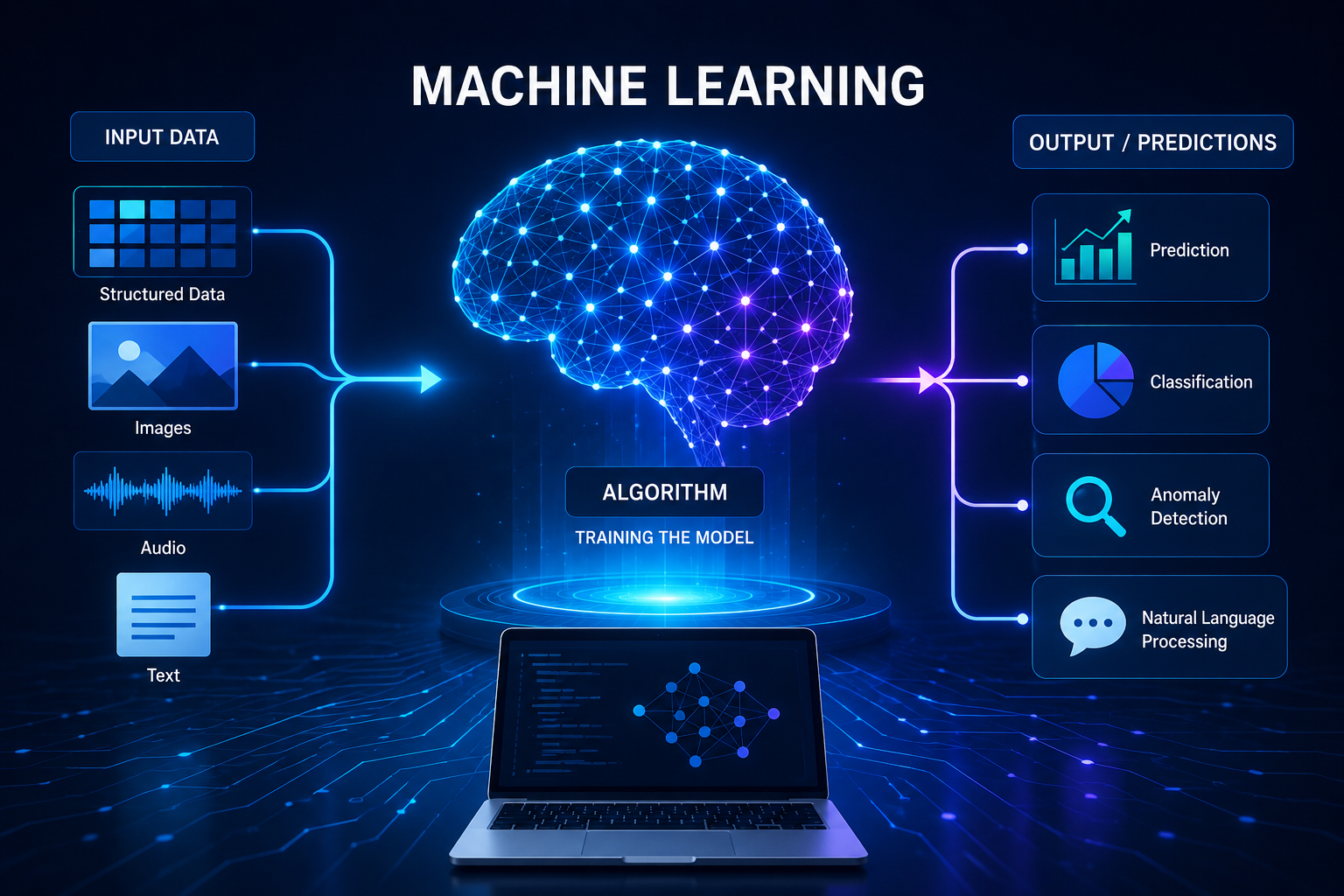
Machine Learning (ML) is a branch of Artificial Intelligence (AI) in which computers learn from data and get better on their own without being told. Another difference with traditional programming is that in ML systems, the pattern is embedded in data and the system is able to make a prediction or decision based on the pattern.
For instance, a spam filter in your email service learns how to differentiate between legitimate emails and spam by analyzing and understanding more email content over time. The adaptability and learning from data is the power and versatility of ML.
Key Concepts of Machine Learning
Machine learning is a fascinating field of study that requires mastering a few core concepts:
1. Data
Data is the foundation of machine learning. It may be organized (such as databases) or unorganized (such as pictures, text, video). The performance of ML models is directly affected by the quality and quantity of data.
2. Features
Features are any measurable property or characteristic of the data. For instance, in a house price prediction model, features may encompass location, number of bedrooms and square footage.
3. Labels
In supervised learning, the desired output or result is called labels. For instance, if you’re training a model to identify images of cats and dogs, the labels would be “cat” or “dog.”
4. Algorithms
Mathematical models that are used to process data and learn patterns are called algorithms. No one single algorithm is appropriate for all tasks like classification, regression, clustering etc.
5. Training and Testing
To “teach” the algorithm a pattern, a training process is used where data is fed into the algorithm. The model is tested using data that it was not trained on, to see how well it performs and generalizes.
6. Overfitting and Underfitting
Overfitting happens when a model learns noise rather than the pattern, resulting in a low performance on new data. Underfitting happens when a model is too simple to capture the data’s complexity.
Types of Machine Learning
In general, machine learning techniques can be classified into three types:
1. Supervised Learning
In supervised learning, models are trained using labeled data. The purpose is to be taught a mapping from inputs to outputs. It can be used in spam detection, image classification, and in predicting house prices.
2. Unsupervised Learning
In this context, models are used to discover the patterns or groups in unlabelled information. A common example of unsupervised learning is clustering and association rule learning, which can be utilized in customer segmentation and anomaly detection.
3. Reinforcement Learning
In Reinforcement Learning, models are trained to make a series of decisions, which are given reward on the basis of desired behaviors. It’s utilized in self-governing vehicles, game playing, such as AlphaGo, and robotics.
Applications of Machine Learning
Machine learning can be used in many fields:
1. Healthcare
ML helps in diagnosis of diseases, drug discovery, and customizing treatment plans. For instance, algorithms can be used to detect tumors in medical images or to predict patient outcomes.
2. Finance
ML is employed in financial institutions to detect fraud, score credit, engage in algorithmic trading, and manage risk. Models are used to detect unusual transactions from analyzing transaction data.
3. Retail and E-commerce
Recommendation systems offer recommendations based on the users’ browsing and purchasing behavior. Customer service chatbots also leverage ML to process customer queries efficiently.
4. Autonomous Vehicles
Self-driving cars are tapping into the power of ML to understand sensor data, identify objects, and make decisions about driving, which is advancing towards the future of autonomous vehicles.
5. Natural Language Processing (NLP)
Language translation, sentiment analysis, voice assistants (such as Siri and Alexa), and interaction with users in a natural way is all possible with ML.
6. Entertainment and Media
ML algorithms streamline content delivery and offer suggestions for personalized content on streaming services.
Challenges in Machine Learning
However, machine learning has been met with a few challenges:
- Data Quality and Bias: Inaccurate or biased data input can result in inaccurate or biased models.
- Interpretability: Complex models such as deep neural networks are sometimes referred to as “black boxes” because it can be difficult to understand how they make their decisions.
- Computing Resources: Complex models demand high computational resources and energy.
- Ethical Concerns: Privacy, consent, and potential misuse issues require responsibly planned and implemented development and deployment.
Future Trends in Machine Learning
There are a number of interesting trends in machine learning that are still in the early stages:
1. Explainable AI
Increasingly, there is more interest in creating interpretable and transparent models, particularly in the fields of healthcare and finance.
2. Edge Computing
By bringing ML processing closer to the data sources (such as IoT devices) latency and bandwidth costs are reduced, allowing for real-time decision making.
3. Automated Machine Learning (AutoML)
AutoML is the goal of automating which model to use and what hyperparameters to tune so that ML is accessible to non-experts.
4. Integration with other technologies
The integration of ML with other emerging technologies such as blockchain, IoT, and augmented reality (AR) will open up new possibilities and applications.
5. Ethics in AI and Regulation
The creation of standards and regulations to guarantee responsible and ethical use of ML will be increasingly important.
Getting Started with Machine Learning
If you are new to the machine learning landscape, here are a few steps to get you started:
- Learn the Basics: Familiarize yourself with programming languages like Python and libraries such as scikit-learn, TensorFlow, or PyTorch. Learn data preprocessing, model training, evaluation metrics and popular algorithms.
- Projects: Solve practical problems with real world datasets from sites such as Kaggle.
- Engage with the Community: Attend forums, webinars, and online courses to stay informed and connect with others.
Conclusion
Machine Learning is an exciting technology that is changing the world of industries and presenting new opportunities. It can process large volumes of data, detect patterns, and make predictions, which makes it highly valuable in various industries. Despite the obstacles involved, further development and research are poised to enhance its features and availability.
For the novice, grasping the principles and gaining some insight into practical applications may open the door to a fruitful career in this exciting area. Machine learning is an intriguing and exciting area to explore, whether you’re looking to create new AI solutions or just understand how these technologies affect our world.