In the 21st century, Machine Learning is one of the most crucial technologies that have been developed. Whether you’re asking for personalised recommendations on your shopping list or ordering from your voice assistant to show you how to avoid scams or even drive your car for you, machine learning is changing how technology is used in business and everyday life. It enables computers to adapt themselves and become more efficient based on data without the need for explicit programming for each individual task.
Whether you have ever asked yourself, “What is Machine Learning and how does it work?”, this guide will clarify all of it in simple words, meaning, working process, types, advantages, applications, and future of Machine Learning.
What is Machine Learning?
Machine Learning (ML): This is one of the areas of Artificial Intelligence (AI) that allows computers to learn from data and make predictions and decisions without having to be programmed for each and every situation.
Computer programs that have been traditionally programmed work according to a set of instructions that have been developed. Machine learning systems, however, require data to learn, see patterns, and get better the more they are fed. This learning capacity can be used for solving problems that are hard to solve using traditional programming.
For instance, Netflix suggests films you might like, Google suggests search terms you are likely to type, and your email filters spam emails: all of this involves machine learning algorithms.
What’s the significance of Machine Learning?
Machine Learning is crucial because of its ability to handle huge quantities of data that are processed rapidly and accurately. It is used in businesses to enhance customer experiences, to automate repetitive tasks, to identify fraud, to identify future trends, and to make smarter decisions.
With the increasing amount of data, it becomes nearly impossible to analyze all the data manually. Machine learning enables the ability to find valuable insights in mere seconds, which saves time and resources.
Machine learning solutions are widely used in modern-day industries like healthcare, finance, retailing, education, transportation, and cybersecurity.
What is the meaning of machine learning?
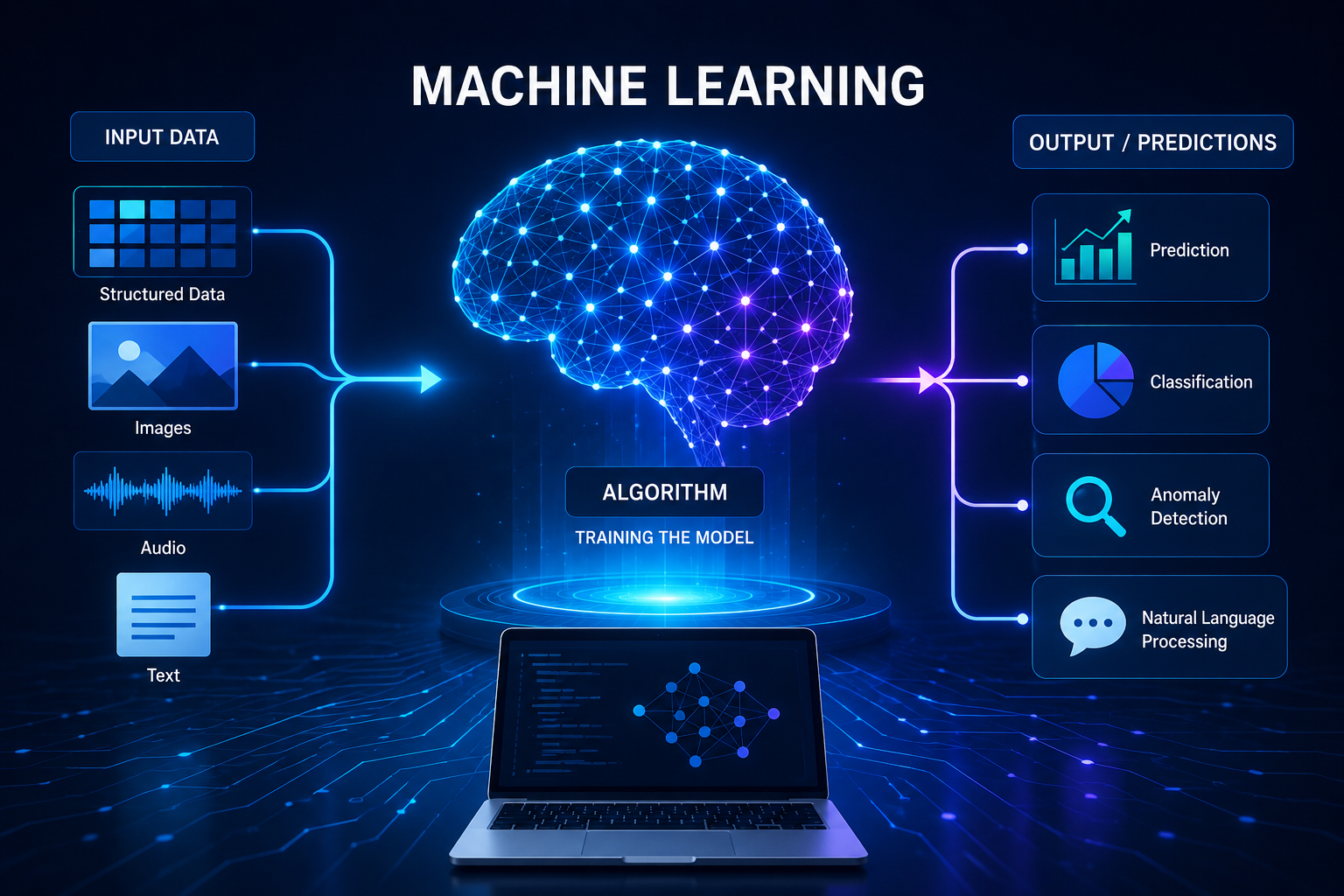
The process of Machine Learning involves data collection, pattern identification, algorithm training, and predictions based on the information learned.
Typically, the first step in the process is to collect relevant data. This data is then cleaned and prepared to eliminate errors, duplicate records, and missing data. When the data is available, the developers select an algorithm for their machine learning model and provide the historical data to train the model.
The model is trained to find relationships among data points. Once model training is finished, it is tested with new data to check its accuracy. Once it is found to be satisfactory, the model is used to solve problems in the real world.
Machine learning models can continue to learn and adapt over time as more data becomes available.
What are the various kinds of machine learning?
There are various categories of Machine Learning that are, in general, divided into various categories according to how the algorithms learn from the data.
Supervised learning: Labelled data with correct answers. This learning is then used to make predictions for new data. It is used in email spam detection, loan approval, and sales forecasting.
Unsupervised Learning: Learning from unlabeled data. The algorithm doesn’t just look for pre-defined answers, but rather it learns to recognize patterns and relationships that exist in the data set. This is a way in which businesses can segment customers and analyze the market.
Reinforcement learning is a different way: The system learns from unlabeled examples rather than from labeled examples. It is rewarded for any correct behavior and punished for any wrong, and over time, it makes better decisions. This technique is popular in robotics, gaming, and self-driving cars.
What is the Difference between Machine Learning and Artificial Intelligence?
There’s a lot of overlap between Artificial Intelligence and Machine Learning, but they are not one and the same.
AI is the larger discipline where the intent is to develop systems that can execute tasks that are usually performed by humans through their brains and senses.
Machine Learning is a branch of Artificial Intelligence that is dedicated to having computers learn from data and get better at a task without having to be explicitly programmed.
A simple way to put it is that all machine learning systems are a component of the field of AI; however, not all AI systems are based on machine learning.
What are some applications for machine learning?
Today, people might not even realize it, but Machine Learning is a part of their everyday life.
Web-based retail outlets suggest products from past purchases and browsing. Services recommend movies and TV shows based on viewing preferences. Machine learning is employed by banks to detect suspicious transactions and fight fraud.
Machine learning is used in healthcare for medical image analysis and disease diagnosis, aiding physicians. It is used by social media platforms to tailor content feeds, and by navigation apps to route users optimally and draw on up-to-the-minute traffic data. It’s being used by social media to help personalize content feeds, and by navigation apps to optimize routes and make use of real-time traffic data.
The practical applications showcase the benefits of machine learning in enhancing business processes and user experiences.
Which Programming Languages Do You Use for Machine Learning?
Python is the most popular programming language for machine learning, owing to its ability to have great libraries like Scikit-learn, TensorFlow, Keras, Pandas, and PyTorch.
Additionally, R is popular for statistical analysis and research, and SQL is integral to data retrieval and management from databases.
These technologies are frequently used together to create a fully-fledged machine learning solution.
What are the Advantages of Machine Learning?
There are many benefits of Machine Learning for individuals and organizations.
It reduces repetitive work, enhances the ability to predict, decreases the chances of human mistakes, analyzes large data sets in a timely manner, and enables better decision-making. Companies can enable customer-centric experiences, streamline operations, and uncover trends that might not be visible to humans.
Algorithms can learn from new information, and within this learning process, they actually improve their performance a lot of the time without constant manual changes.
What are the challenges in Machine Learning?
While there are many advantages to using Machine Learning, there are also some drawbacks.
Data quality is critical because poor data quality can lead to poor results. Machine learning models need to be developed skillfully, with the help of computational resources, and continuously monitored.
Ethical issues, privacy laws, and transparency are also crucial factors for organizations to take into account when implementing machine learning systems, particularly in sectors where decisions could impact individual lives.
How to Start Learning Machine Learning?
A big part of learning machine learning begins by knowing the basics of programming, mathematics, and statistics. Python is a great language for beginners; it’s simple but has a lot of machine learning libraries.
Once the basics have been learned, beginners should get hands-on and build projects on real-life data. Gaining insights into data preprocessing, visualization, model training, and evaluation aids in cultivating practical skills.
Hands-on experience can also be gained from online courses, tutorials, open-source projects, and coding challenges.
What Future of Machine Learning?
The future of Machine Learning holds even greater promise as businesses increasingly invest in automation and intelligent technologies.
The future will bring more advancements in healthcare diagnostics, financial forecasting, cybersecurity, scientific research, smart manufacturing, and personalized education. As machine learning models gain sophistication, they will help humans to tackle more complex problems and boost efficiency in numerous sectors.
Machine learning will not replace humans outright – instead, continue to assist them with tasks that are repetitive and offer data-driven insights to aid in decision-making.
Conclusion
Machine Learning is one of the more significant technologies of present-day computing. It allows computers to learn from data and enhance themselves automatically, which powers many of the digital services people use on a daily basis. Whether it’s in the form of recommendations, fraud detection, healthcare, or autonomous vehicles, machine learning is revolutionizing industries around the globe. It’s a crucial introduction to anyone interested in technology, artificial intelligence, or data science.
Frequently Asked Questions
What is Machine Learning?
Machine Learning is one of the fields of Artificial Intelligence that allows computers to learn from data, recognize patterns, and make predictions without programming them for each specific case.
How does Machine Learning work?
The principle behind Machine Learning is to learn from data, identify patterns, make predictions, and get better at what they do as more data comes in.
Is Machine Learning a component of Artificial Intelligence?
Yes. Machine Learning is one type of Artificial Intelligence that aims to develop a machine that can learn from data without human involvement.
What are the main types of Machine Learning?
There are three key learning types: supervised learning, unsupervised learning, and reinforcement learning.
What programming language is the most suitable for Machine Learning?
Its extensive libraries like TensorFlow, Scikit-learn, Pandas, and PyTorch make Python the most popular language.
What are some of the applications of Machine Learning?
Machine Learning is applied to automate jobs and make decisions in the fields of healthcare, finance, e-commerce, cybersecurity, education, transportation, entertainment, and more.