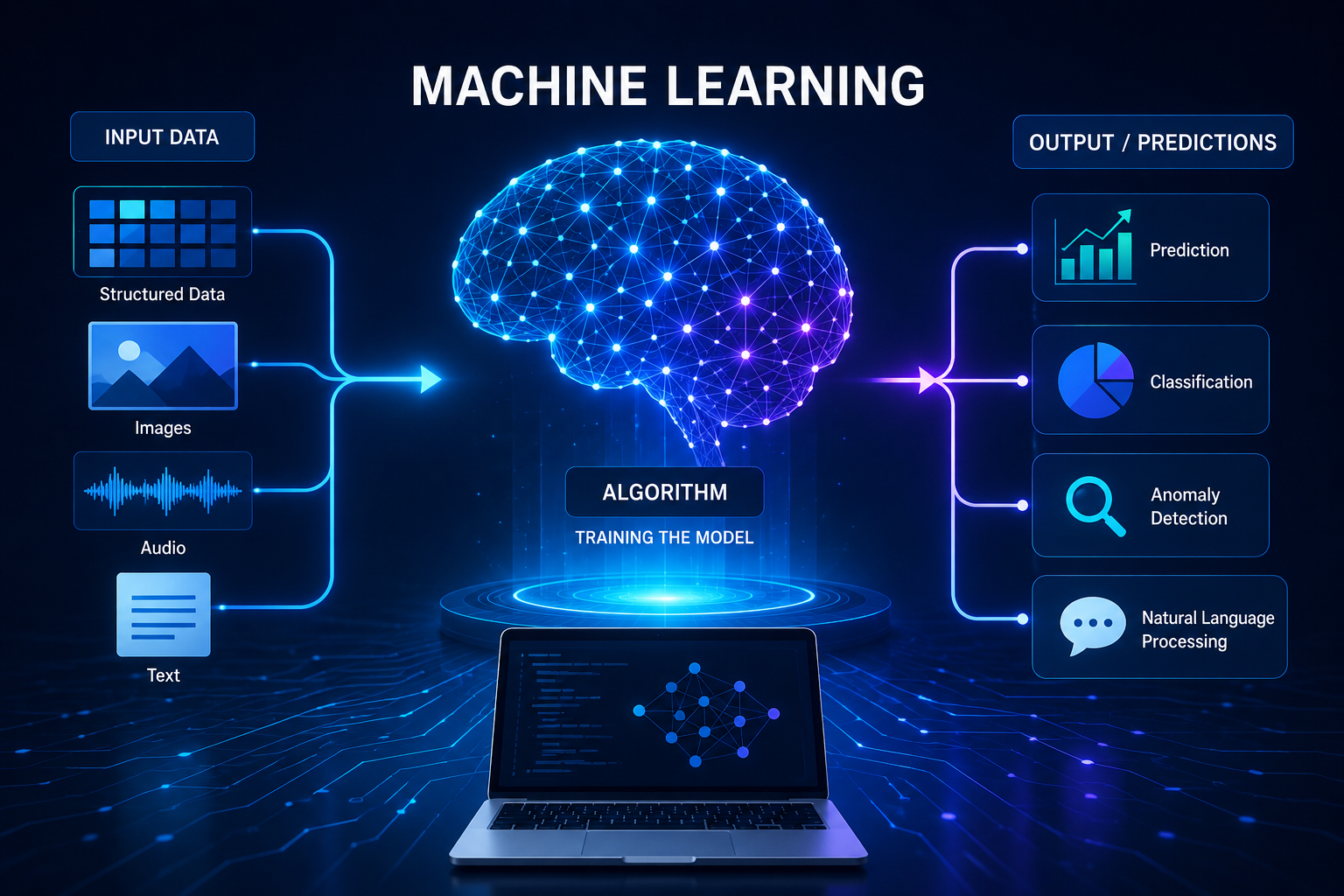
Machine learning (ML) is a crucial technology for companies seeking to enhance efficiency, automate repetitive tasks, and make informed decisions. Organizations can leverage machine learning models to process vast quantities of data, uncover trends, make predictions, and continually optimize business processes, rather than just depending on conventional software.
However, off-the-shelf machine learning solutions don’t necessarily meet the requirements of each company. That’s where custom machine learning development services can come in handy. Custom solutions are tailored to a company’s goals, data, processes, industry needs and customers.
Predictive analytics, recommendation engines, fraud detection, and intelligent automation—these are just a few possibilities for custom machine learning that can enable businesses to create solutions that closely match their objectives.
What Are Custom Machine Learning Development Services?
Custom machine learning development services include custom design, development, training, deployment, and maintenance of machine learning solutions for a business’s unique needs.
A custom machine learning solution can be built upon a company’s current infrastructure and business processes, in contrast to generic software. Project-based, development teams can choose from the right algorithms, data-processing methods, cloud technologies, APIs, and approaches to deployment.
Common custom ML solutions include:
- Predictive analytics platforms
- Recommendation systems
- Customer segmentation models
- Fraud detection systems
- Demand forecasting tools
- Natural Language Processing applications
- Computer vision solutions
- Intelligent automation systems
- Predictive maintenance applications
- AI-powered business analytics
What Makes Custom Machine Learning Development Services Worth Investing In?
1. How can custom machine learning enhance business efficiency?
Better operational efficiency is one of the greatest benefits of custom machine learning. These are all repetitive tasks that businesses can be handling, including data classification, document processing, customer enquiries, forecasting and quality monitoring.
Many of these tasks can be automated using machine learning, thereby minimizing the manual efforts needed. This will then allow workers to concentrate on higher-level tasks that demand creativity, communication and human judgment.
The solution is tailored to the business, so they can identify the operations that can gain the most value from automation.
2. What is the role of machine learning in making better decisions?
Companies collect vast customer and site data, application and transaction data, sales systems data and more. Without the proper technology, it can be challenging to transform this data into useful information.
Historical data and real-time data can be used to detect patterns and relationships with the help of custom machine learning models. The data can be used for various purposes, such as forecasting, risk assessment, customer analysis, inventory planning, and other business decisions.
For example, a retailer may use machine learning to analyze historical purchasing behavior and forecast potential demand for different products.
3. Can Custom ML Solutions Improve Customer Experiences?
Customer expectations are constantly changing and businesses must deliver a personalized experience on digital channels. With custom machine learning development, organizations can gain insight into their customers’ behavior, and provide more personalized interactions.
Recommendation engines can offer products or content, based on user behavior. Machine learning can also be used to aid intelligent chatbots, customer segmenting, sentiment analysis, and personalization in marketing.
Business-specific facts and goals can make it possible for custom-made ML options to deliver more pertinent experiences than standard automation tools.
4. What does machine learning development have to do with scalability?
Businesses change as they grow. They can grow in volume of data, customer base, product line and need over time.
A custom machine learning solution can be designed incorporating scalability. Developers can create systems that can handle the expansion of data and more users, applications, or business functions.
Cloud infrastructure might even assist businesses with the ability to scale computing resources as they require. This means that it’s a good idea for companies that are looking at long-term digital transformation.
5. How can Custom Machine Learning Save Your Money?
More cost optimization can be achieved by automation and better forecasting. Machine learning can optimise resource allocation, pinpoint inefficiencies and minimise manual efforts.
For instance, predictive maintenance models can work on equipment data and pinpoint potential issues prior to major breakdowns. Likewise, demand forecasting can assist businesses to control inventory more efficiently.
The ROI will vary based on the use case, data quality, implementation, and operational environment, but measurable business value can be achieved through targeted automation.
6. What are the advantages of Custom ML in data security and fraud detection?
Security and fraud are paramount issues for organizations with financial, customer or transactional data. Patterns of activity can be detected by machine learning, and activity is also brought to light that is unusual.
Business-specific transaction patterns and risk indicators can be used for training custom fraud detection systems. They can help identify potentially suspicious activities for further investigation.
Machine learning can be used in conjunction with existing security and monitoring systems, avoiding the need to establish a new technology environment.
7. What competitive advantage can machine learning offer?
Data-driven companies can benefit in customer service, product development, forecasting, operational planning, and more.
With custom machine learning, businesses can develop solutions that others might not be able to easily replicate. In addition to the off-the-shelf features that are available to all organizations, organizations can create models based on their own data and processes.
This can enable innovation and faster business reaction to market changes.
What Technologies Are Used in Custom Machine Learning Development?
Depending on the project’s needs, the use of multiple technologies is possible in the case of custom machine learning projects. Popular technologies are Python, TensorFlow, PyTorch, scikit-learn, cloud platforms, databases, APIs, data-processing frameworks and MLOps tools.
Some technologies that can be leveraged by developers include natural language processing, computer vision, deep learning, generative AI and predictive analytics.
The technology stack needs to be chosen based on the project goals, data needs, performance goals, security needs, and scalability requirements, and not just the latest technology.
How Should Businesses Choose a Custom Machine Learning Development Partner?
Selecting the right development partner is crucial as effective machine learning projects go beyond model development. Businesses should consider the technical skills, industry experience, development process, data-security measures, integration options and after-launch support of a provider.
In addition, a good provider will be familiar with the business challenge and suggest the appropriate technology solution. Having well-documented project goals, measurable performance measures, data needs, and deployment plans will minimize development risk.
The Future of Custom Machine Learning Development is Uncertain
As more and more companies integrate AI-powered applications into their operations, machine learning is likely to play a key role in business technology. New opportunities are emerging for organizations in various sectors due to the developments in generative AI, automation, predictive analytics, computer vision, and natural language processing.
Companies who build solid data foundations, and create practical machine learning applications, may be better-equipped to capitalize on those innovations.
Conclusion
By leveraging custom machine learning development services, businesses can tackle unique operational and strategic challenges by implementing intelligent, data-driven solutions. Custom ML solutions can be used to enhance various business goals, including automation, predictive analytics, personalization, fraud prevention, and better decision-making.
The best way is to start with a business problem and then choose the right machine learning technologies, data strategy, and architecture. As long as they are implemented and optimized appropriately, custom machine learning can be an asset to long-term digital transformation.